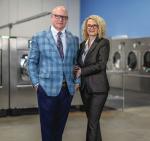
MIAMI — Like many in the industry, Luis Aguilar didn’t plan to go into the commercial laundry business.
He had studied at Virginia Tech, worked for General Electric as an industrial engineer, and spent time in private equity.
But his goal was to acquire and successfully run his own business.
So, he learned the art of making business deals, practiced his skills, and finally took the plunge in 2022 — buying a laundry operation.
“I acquired Cy’s Linen and, over the years since, built on that foundation through a series of acquisitions rather than organic, single-family growth,” shares Aguilar.
He has accomplished this through the purchase of four more operations, which now operate under three customer-facing brands at five facilities under one ownership group.
But Aguilar’s ambition hasn’t diminished. Earlier this year, he rebranded the parent company that owns the operations as Elavo. He also unveiled a plan to establish a regional and, eventually, national platform for laundry owners looking to sell their businesses.
REGIONAL, NATIONAL EXPANSION
The idea to grow Elavo regionally and beyond grew directly out of what Aguilar was already doing.
“Each acquisition reinforced the same lesson: a well-run local laundry gets meaningfully stronger when it can plug into shared purchasing, shared systems, and shared operational know-how and cross-facility redundancy, without losing what made it successful with its customers in the first place,” he says.
“Bringing Perfect Linen and SurGlobal into the Cy’s and SerClean brands, in particular, showed how a strong local operation could be integrated quickly and still keep serving its customers without missing a beat.”
At the same time, Aguilar saw an industry made up largely of well-run, independent, often family-owned laundries with strong local reputations, loyal customers, and owners thinking about the next chapter for their business.
“Elavo was born from connecting those two observations,” he shares. “If this approach worked at the scale of five facilities, the same playbook could work for other independent operators who want to keep serving their customers well but could use the scale, systems, and resources of a larger platform behind them.
“That’s the thesis behind building Elavo into a regional, and eventually national, platform for commercial laundry and linen services.”
Benjamin Mandowsky, vice president of Corporate Development and Mergers & Acquisitions for Elavo, says the company’s acquisition process is straightforward and respectful, built around getting to know an operator and their business before anything else.
“[The process] typically starts with an introductory conversation to understand the owner’s goals, the story of the business, and what matters most to them in a partner — whether that’s continuity for their employees, certainty of closing, or simply finding the right home for something they’ve built over many years,” he says.
From there, the process moves into a period of mutual due diligence, which includes understanding the financial and operational profile of the laundry in consideration. Elavo will spend time in the plant making sure there’s a genuine fit with standards and culture.
“If both sides want to move forward, we work together on valuation and deal structure, aiming for a process that’s transparent and efficient rather than long and draining,” shares Mandowsky.
“Once a transaction closes, our focus shifts to integration — bringing the operation onto shared systems and purchasing programs, sharing operational best practices, and, depending on the business, bringing it under an existing Elavo brand or keeping its own name, whichever serves the customer relationships best.”
He also points to the acquisitions of Perfect Linen and SurGlobal as good examples of how this works in practice. Both were strong, independently run operations serving hospitality customers in their respective markets. Rather than operate them as stand-alone entities, Elavo integrated Perfect Linen into the Cy’s Linen brand and SurGlobal into the SerClean brand, giving customers continuity of service while folding each facility’s capacity, purchasing, and operations into the broader platform.
“Florida Keys Linen, by contrast, kept its own name because that identity carries real weight with its customer base in the Keys,” points out Mandowsky. “That flexibility, deciding brand strategy case by case, rather than forcing every acquisition into a single mold, is central to how we plan to partner with laundries going forward.”
He stresses that Elavo is built and led by operators, not by a financial sponsor working toward a predetermined exit timeline.
“We’ve run these businesses ourselves,” shares Mandowsky. “We understand the day-to-day realities of the plant floor, and our decisions are grounded in operating experience rather than a spreadsheet-first view of the industry.
“That shows up in how we approach partnerships. We’re not looking to strip out costs, force a single brand identity on every operation on day one, or move on to the next deal without regard for what happens after closing. Our interest is long-term stewardship of the businesses and the people who make them work, paired with the discipline and resources to help those businesses grow.
“We think that combination, genuine operating experience plus a long-term ownership mindset, is what differentiates Elavo from private equity-backed consolidators and other national players in this space.”
He adds that Elavo knows how much local brands matter in this business.
“Customers build relationships with names like Cy’s Linen, SerClean, and Florida Keys Linen that have served their regions for years and carry real trust in their markets,” says Mandowsky. “Rather than erase that in favor of a single national banner, we keep those strong local brands in place wherever it makes sense, so customers keep the relationship and reputation they already trust, backed by the resources of a larger platform.”
Rolando De Leon, chief operating officer of Elavo, adds that as the company brings new operations into the platform, one of the first things it focuses on is aligning purchasing across textiles, chemicals, and other core supplies.
“Combining volume across facilities gives us better pricing and priority with vendors, and it lets us standardize on quality specifications, so customers get a consistent product no matter which plant is serving them,” he says.
“We also think about supply-chain resiliency broadly by maintaining relationships with more than one supplier for critical inputs, keeping appropriate inventory buffers, and sharing what we learn at one facility across the rest of the network.
“As the platform grows, we expect those purchasing programs to become an increasingly important source of value for the operations that join us, on top of the operational and back-office support we already provide.”
FUTURE GOALS
While the Elavo brand is new, Aguilar hopes it will be recognized as one of the leading platforms in commercial laundry and linen services in 10 years.
“Our vision is to grow our footprint from our South Florida base into a true regional, and ultimately national, presence,” he emphasizes. “We want that growth to come from partnering with other well-run, independent operators who see the same value in joining forces that we’ve seen firsthand, not from simply buying market share.
“Just as importantly, we hope Elavo is known as a platform that did that growth the right way: preserving what made each business successful, taking care of the people who do the work every day, and building a reputation with customers and partners as a company that keeps its word.”
Click HERE to read part 1 about Elavo’s roots.
Have a question or comment? E-mail our editor Matt Poe at [email protected].